The Quincunx Inconjunct Aspect in Astrology: Meaning, Natal Charts & Transits
Learn what the 150° quincunx means in astrology, how natal and transit quincunxes differ, and why Astro Number Guide reads this aspect as recalibration.
A quincunx or inconjunct is a 150° astrological aspect between two planets or chart factors whose functions do not naturally coordinate. It can create an awkwardness or discomfort — a persistent little itch that draws our attention.
Unlike a square, which tends to create obvious dissonance, or an opposition, which creates a more direct polarity between two functions, the quincunx has a different quality. It draws our attention to something that does not quite fit and invites us to investigate why.
This astrological aspect reminds us to look in a certain direction, ask unexpected questions, and make discoveries we otherwise wouldn't have made.
Something does not quite fit.
And at Astro Number Guide, the central principle of the quincunx is recalibration.
The question is not: Which side is correct?
But rather: What is being brought to my attention that can be fine-tuned for a better way forward?
The answer depends on context, and this aspect can occur in three formats:
A natal aspect is part of the birth chart — the planetary pattern present at the moment of birth — so a natal quincunx describes an enduring relationship between two functions that develops through repeated adjustment across life.
A transit describes the current movement and relationships of planets in the sky. A transiting quincunx creates a temporary period of recalibration within the wider astrological weather. How personally significant it becomes depends on how that pattern interacts with the birth chart — sometimes strongly, sometimes only lightly.
In synastry, which compares two birth charts, the quincunx describes two people's planetary functions that may need conscious accommodation in order to work together.
Table of Contents
- What Is a Quincunx in Astrology?
- The Core Meaning of the Quincunx: Recalibration
- The Numerological Meaning of 150° in Astro Number Guide
- What Does a Quincunx Feel Like?
- Natal Quincunx, Transit Quincunx and Synastry Quincunx
- How Astro Number Guide Reads a Quincunx
- The Signs in a Quincunx
- Quincunxes in a Yod
- What Orb Do We Use for a Quincunx?
- Is the Quincunx a Minor Aspect?
- Can a Quincunx Be Positive?
- Is a Quincunx Karmic?
- FAQ About the Quincunx
- Final Summary

What Is a Quincunx or Inconjunct in Astrology?
Geometrically, the quincunx, also known as inconjunct, sits 30° beyond a trine and 30° before an opposition. It therefore occupies a relationship that is neither naturally flowing nor directly polarised.
The two functions are not necessarily enemies.
They are not necessarily opposites.
They simply do not come with an obvious method of coordination.
One function may require more time, freedom, structure, intensity, flexibility or containment than the other can easily accommodate.
The quincunx asks us to notice the mismatch and adjust the arrangement.
The Core Meaning of the Quincunx: Recalibration
At Astro Number Guide, we interpret the central intelligence of the quincunx as recalibration.
A quincunx is better understood as a mismatch than as a simple conflict.
Conflict suggests that two functions actively oppose one another.
Incompatibility suggests that they cannot successfully coexist.
Mismatch means that both may be legitimate, but their requirements do not automatically align.
That is the territory of the quincunx.
Its practical questions are:
- What has become out of proportion?
- Which function is being over-accommodated?
- Which function is receiving too little space?
- What no longer fits the way it once did?
- What practical adjustment would allow both functions to operate?
- What needs to change without requiring either side to disappear?
A natal quincunx is not something we simply resolve once and leave behind. The relationship between the two functions continues to develop, asking for ongoing recalibration as circumstances, priorities and awareness change.
The geometry remains. The way we live it evolves.
This is also why the signs and houses involved matter so much when interpreting a quincunx. The signs describe how each planetary function expresses itself and what it requires, while the houses show where that relationship is being lived out in practical life.
A quincunx between the same two planets can therefore feel very different depending on the signs they occupy and whether the adjustment is playing out through work, relationships, creativity, home, health, identity or another area of life.
Because the quincunx is so closely connected with lived adjustment, these details can make the aspect remarkably precise.
Maturity does not necessarily mean that a natal quincunx reaches a final resolution. It can instead mean becoming increasingly skilled at recognising when something is out of balance, understanding what the two functions require, and making conscious adjustments as life continues to change.
A transit works differently because the aspect itself is temporary. It asks what needs recalibrating under present conditions.
The Numerological Meaning of 150° in Astro Number Guide
Astro Number Guide explores astrological geometry together with numerology.
For the quincunx, we apply numerological reduction to its conventional degree measurement:
150°
1 + 5 + 0 = 6
Within the Astro Number Guide system, 6 is associated here with embodiment, lived reality, practical coherence and making something workable in practice.
This creates a striking correspondence with the astrological geometry.
Astrologically, the quincunx tells us:
These two functions do not automatically coordinate.
Through the numerological lens of 6, the question becomes:
How can they be made workable in lived reality?
This is why practical feedback matters so much when interpreting the aspect. A theoretical arrangement may seem perfectly reasonable while the lived version tells a different story.
The body may show that the current pace is unsustainable.
A schedule may stop working.
Responsibilities may exceed available capacity.
A relationship may need renegotiation.
A creative method may begin restricting the work it was meant to support.
The numerology does not replace the astrology. It adds another layer to the same geometric question: can this arrangement actually be lived?
What Does a Quincunx Feel Like?
A quincunx has a different quality from a square or opposition.
Rather than creating the same kind of direct friction or polarity, it can produce a persistent sense that something does not quite fit or that two legitimate needs are not coordinating properly.
In a natal chart, this may appear as:
- repeatedly favouring one function until the other becomes impossible to ignore;
- compensating strongly in one direction and later correcting back;
- difficulty satisfying two legitimate needs simultaneously;
- recurring adjustments involving timing, energy, responsibility, boundaries or priorities;
- becoming highly sensitive to small imbalances;
- discovering that an arrangement which once worked no longer does.
The quincunx often becomes visible through feedback. Something in lived reality begins showing that the relationship between the two functions needs attention.
In transit, the experience may be similar but temporary. A particular period might show that your workload no longer fits your energy, that a relationship needs different boundaries, or that a method which worked before no longer suits current conditions.
The geometry is the same. The time scale is not.
Natal Quincunx, Transit Quincunx and Synastry Quincunx
The same 150° geometry can appear in several different astrological contexts:
Natal quincunx: two positions in the birth chart form a quincunx. The geometry is lifelong, and the relationship between the two functions develops through continuous recalibration. The central question is: How can these two functions learn to work together more consciously?
Transit quincunx in the sky: two currently moving planets form a quincunx with one another. This becomes part of the wider astrological weather and describes a temporary collective pattern of adjustment and recalibration.
Transit quincunx to the natal chart: a moving planet forms a quincunx to a natal planet or point. Here, the current astrological weather intersects directly with the birth chart, bringing a more personally specific area of adjustment into focus. The central question is: What is asking to be recalibrated under present conditions?
Synastry quincunx: one person's natal position forms a quincunx to another person's natal position. The inter-chart geometry is stable and describes two planetary functions that may require conscious accommodation within the relationship. The central question is: How can these different needs or ways of operating coexist more effectively?
Transit activation in synastry: current transits can activate one or both natal positions involved in a synastry quincunx, temporarily bringing that relationship dynamic into stronger focus. The underlying synastry aspect does not change, but the way it is experienced can become more immediate and may call for fresh adjustment.
So the central principle remains recalibration, but the context changes:
Natal — continuous recalibration.
Transit in the sky — collective or situational recalibration.
Transit to the natal chart — personal recalibration under current conditions.
Synastry — relational recalibration.
Transit activation in synastry — temporary activation of an existing relational pattern.
These layers can also overlap. A quincunx may exist in the natal chart or between two people's charts while current transits simultaneously activate one or both sides of it, making the need for recalibration especially noticeable for a time.
The Complexity of the Wider Picture
A quincunx becomes much more precise when we stop looking at the aspect in isolation and begin reading it as part of the wider astrological picture.
The two planets give us the basic functions involved, but from there we can follow the threads. We can look at the signs they occupy, the houses they fall in, the houses they rule, and where those rulers lead us next. We can notice whether the same themes appear elsewhere in the chart, whether other planets are connected to the quincunx, and whether several different placements seem to be pointing toward the same underlying question.
Sometimes what initially looks like a simple mismatch between two planets turns out to be part of a much larger pattern. Following the rulers may connect apparently separate areas of life. Another aspect may reveal why one side of the quincunx is especially important. Repeating signs, houses, planets or themes can show us where the chart is placing particular emphasis.
The current sky adds another layer. Every aspect in the sky is part of the wider energetic weather, and that weather moves through both the collective and the individual. We can think of it as filtering down through layers of collective and personal experience, always reaching the hearts, minds and lived realities of individuals.
The natal chart helps us understand how that energy is received and where it may become especially concentrated. A transiting quincunx may activate an existing natal pattern, touch an important planet or angle, move through particular houses, or echo themes already present elsewhere in the chart.
This does not make the aspect more or less real. It makes its expression more specific.
Astrological aspects are always precise. The deeper we read the connections between the current sky and the natal chart, the more clearly we can see what kind of support, awareness or recalibration is being offered and where it is asking to be applied.
Astrology can become extraordinarily detailed when we follow these connections, and there is always more of the chart to explore.
But for a start, we can take the first step by looking at two of the clearest clues available to us: the signs and the houses.
How Astro Number Guide Reads a Quincunx
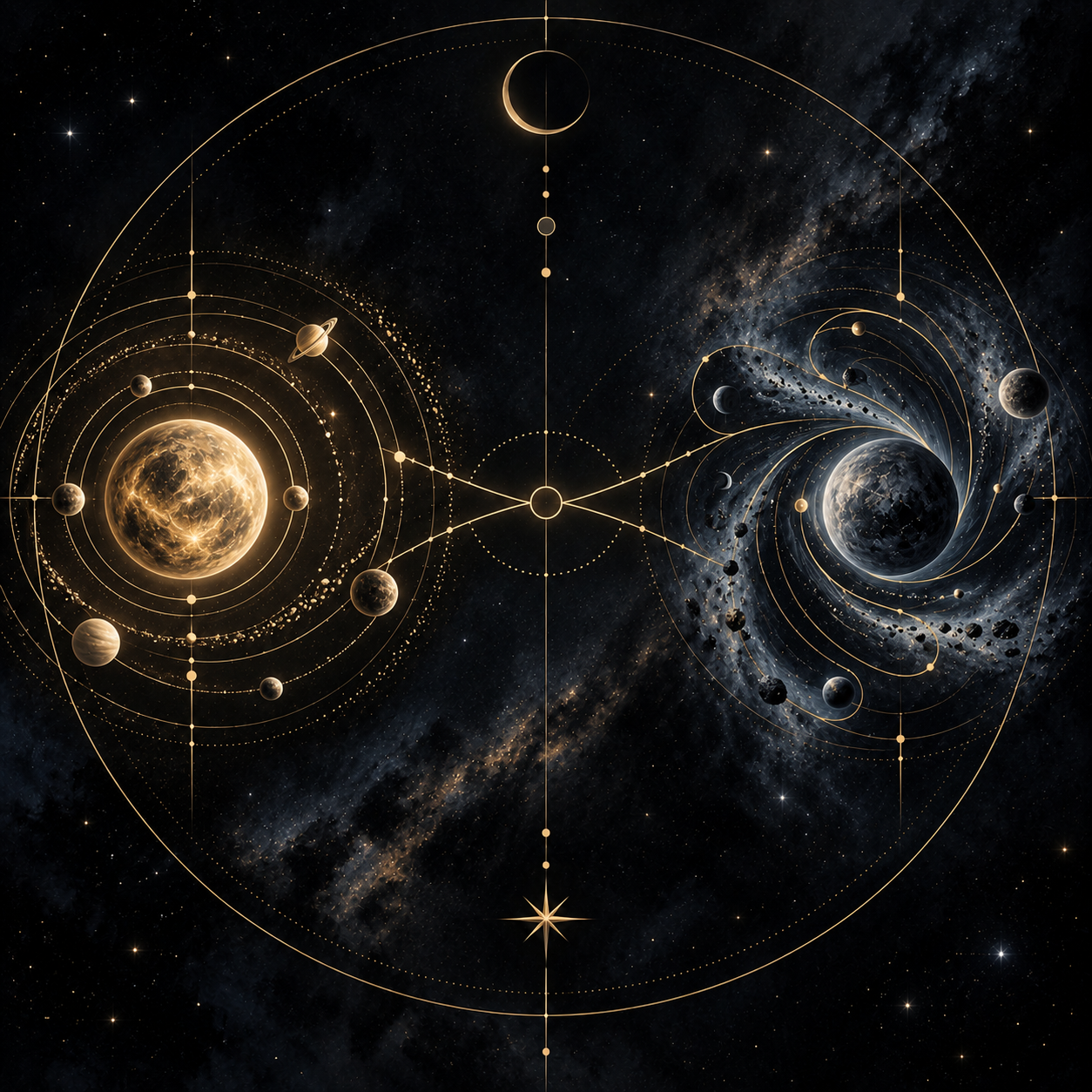
Astro Number Guide reads the quincunx as part of the entire chart. The core method is:
- Identify the functions. What does each planet, point or asteroid do?
- Add the signs. How does each function behave?
- Add the houses. Where does each function operate in lived experience?
- Read the geometry. What prevents the two functions from coordinating automatically?
- Identify the context. Is the quincunx natal, transiting or between two charts?
- Follow the rulers. Where do the relevant house systems lead?
- Examine supporting aspects. Is the quincunx part of a larger configuration?
- Look for repetition. Does the same theme appear elsewhere in the chart?
- Add the numerological layer. What does the 150° → 6 vibration contribute?
- Return to lived reality. What adjustment makes both functions more workable in practice?
For a transit, timing is also essential: when does the aspect become exact, and when does it move out of orb?
For synastry, reciprocity matters: can the required adjustments genuinely work for both people?
The aim is to understand the architecture of the mismatch and the kind of recalibration it requires.
The Signs in a Quincunx
Signs connected by an exact 150° relationship generally share neither element nor modality. That helps explain why their operating styles may not immediately understand one another.
These are the natural sign combinations that form a quincunx or inconjunct:
- Aries: Virgo, Scorpio
- Taurus: Libra, Sagittarius
- Gemini: Scorpio, Capricorn
- Cancer: Sagittarius, Aquarius
- Leo: Capricorn, Pisces
- Virgo: Aries, Aquarius
- Libra: Taurus, Pisces
- Scorpio: Aries, Gemini
- Sagittarius: Taurus, Cancer
- Capricorn: Gemini, Leo
- Aquarius: Cancer, Virgo
- Pisces: Leo, Libra
However, the sign relationship alone is not the interpretation.
Mars in Aries quincunx Venus in Virgo is therefore not equivalent to Saturn in Aries quincunx Moon in Virgo. The sign pair may be the same; the functions involved are not.
Quincunxes in a Yod
A Yod is an aspect configuration in which two planets form a sextile to one another while both form quincunxes to a third planet.
That third planet is commonly called the apex or focal point.
Astro Number Guide begins with the geometry rather than attaching a dramatic meaning to the label.
Two separate planetary functions are both forming a quincunx to the same apex. The apex therefore becomes a convergence point for recalibration.
Useful questions include:
- What does the apex planet represent?
- Which sign and house does it occupy?
- What are the two planets at the base contributing?
- How does their sextile operate?
- What does each quincunx require from the apex?
- Which houses do all three planets rule?
- Where do those ruler chains lead?
- Is the same pattern reinforced elsewhere in the chart?
A Yod can therefore concentrate the quincunx principle. Its significance comes from the architecture of the configuration, not from the label alone.
What Orb Do We Use for a Quincunx?
Astro Number Guide generally works with relatively tight geometry.
As a working guideline:
- planets and luminaries: usually within approximately 2°;
- asteroids: usually within approximately 1°.
The closer the quincunx is to exact, the more interpretive weight we give it.
For transits, exactness is also useful for identifying when the period of recalibration is most concentrated.
A wider contact may still matter when it participates in a larger pattern or repeats an important theme elsewhere in the chart, but it should not automatically receive the same weight as a nearly exact quincunx.

Is the Quincunx a Minor Aspect?
In modern astrology, the quincunx is commonly classified as a minor aspect because it falls outside the five major aspects traditionally emphasised in Western astrology: conjunction, sextile, square, trine and opposition.
"Minor" does not mean meaningless.
A quincunx can become highly significant when it is:
- extremely exact;
- connected with the Sun or Moon;
- connected with an angle;
- part of a Yod;
- formed by important house rulers;
- repeated elsewhere in the chart;
- activated by significant transits or progressions.
Astro Number Guide therefore prioritises geometry, repetition and structural relevance rather than relying on the label "major" or "minor" alone.
Can a Quincunx Be Positive?
Yes.
The quincunx is not inherently negative.
Its difficulty lies in the absence of automatic coordination, but that same quality can develop considerable skill.
A natal quincunx may cultivate:
- adaptability;
- precision;
- timing;
- practical intelligence;
- sensitivity to subtle imbalance;
- willingness to revise;
- capacity to accommodate complexity;
- awareness of competing needs.
Someone who has spent years consciously working with a quincunx may become unusually good at noticing small discrepancies before they become larger problems.
A transit quincunx can also be useful. It may reveal that something needs adjustment before the mismatch develops into a more serious consequence.
The discomfort contains information.
Is a Quincunx Karmic?
A quincunx is not automatically karmic simply because it is uncomfortable, unusual or difficult to integrate.
Astro Number Guide would look for additional chart architecture before assigning a strong karmic dimension to the aspect.
Relevant factors might include:
- the lunar nodes;
- Saturn;
- Pluto;
- Chiron;
- important angles;
- significant asteroids;
- repeated ruler chains;
- surrounding numerology;
- other reinforcing configurations.
A quincunx involving several of these factors may participate in a larger storyline that carries karmic significance within the interpretive framework being used.
But the quincunx itself tells us something simpler first:
These functions require recalibration.
The rest of the chart tells us why that relationship matters and how deeply it is woven into the chart's larger architecture.

FAQ About the Quincunx
What Does Quincunx Mean in Astrology?
A quincunx is a 150° relationship between two planetary functions that do not naturally coordinate.
At Astro Number Guide, we interpret its central dynamic as recalibration: identifying what needs adjustment so both functions can operate without requiring either one to disappear.
Is Quincunx the Same as Inconjunct?
The terms are commonly used interchangeably in modern astrology.
Astro Number Guide generally uses quincunx when referring specifically to the 150° geometry.
Is a Quincunx a Difficult Aspect?
It can be uncomfortable because coordination is not automatic, but it is not inherently negative.
Its difficulty often comes from having to recognise a mismatch that is subtler than the direct friction of a square or the polarity of an opposition.
What Does a Natal Quincunx Mean?
A natal quincunx is a 150° relationship contained within the birth chart.
It describes two functions whose relationship requires repeated recalibration throughout life. The aspect remains, but the way a person works with it can develop considerably.
What Does a Quincunx Transit Mean?
A quincunx transit occurs when a planet moving through the current sky forms a 150° relationship to a natal planet, angle or point.
It describes a temporary period in which present conditions require an established natal function to adjust.
What Does a Quincunx Mean in Synastry?
In synastry, a quincunx connects one person's natal planet with another person's natal planet.
It can show planetary needs or behavioural styles that do not automatically understand or accommodate one another. It may therefore require communication, translation and practical adjustment, but it does not automatically mean the two people are incompatible.
What Is the Orb for a Quincunx?
Astro Number Guide generally prioritises quincunxes within approximately 2° for planets and luminaries and 1° for asteroids.
The closer the aspect is to exact, the greater the interpretive weight we normally give it.
Can a Natal Quincunx Be Resolved?
Not necessarily through one permanent solution.
A mature expression of the aspect may be the ability to recognise imbalance early and make appropriate adjustments as life circumstances change.
Does a Transit Quincunx Create a Permanent Problem?
No.
A transit is temporary. It may reveal something important about an existing arrangement, but the transit itself does not become a permanent natal condition.
Is a Quincunx Bad in Synastry?
Not necessarily.
A quincunx can create misunderstanding or awkwardness because two planetary functions operate differently, but the entire relationship between the charts matters. Other aspects may provide considerable affinity, attraction, emotional understanding or stability.
Is a Yod Made of Quincunxes?
Yes.
A standard Yod consists of two planets in sextile, with both forming a quincunx to a third planet at the apex.
Final Summary
The quincunx is a 150° aspect of recalibration.
Its two functions do not naturally coordinate, but that does not necessarily mean they are in direct conflict or incapable of coexistence.
The central issue is mismatch.
In a natal chart, the quincunx describes an enduring relationship between two functions that develops through repeated adjustment across life.
In a transit, the same geometry describes a temporary period during which current circumstances require an established natal function to adapt.
In synastry, the quincunx connects planetary functions belonging to two different people and asks whether their different needs and operating styles can be consciously accommodated.
Within Astro Number Guide, the conventional degree measurement of the quincunx — 150° — reduces numerologically to 6, adding the themes of embodiment, lived reality and practical coherence to the interpretation.
The aim is not to force one function to disappear.
Nor is it necessarily to discover one perfect arrangement that will remain correct forever.
The deeper intelligence of the quincunx lies in recognising when the relationship between two valid realities has moved out of alignment.
Its question is therefore simple:
Can both realities work together in practice — and what needs adjusting for that to become possible?